英语
英语
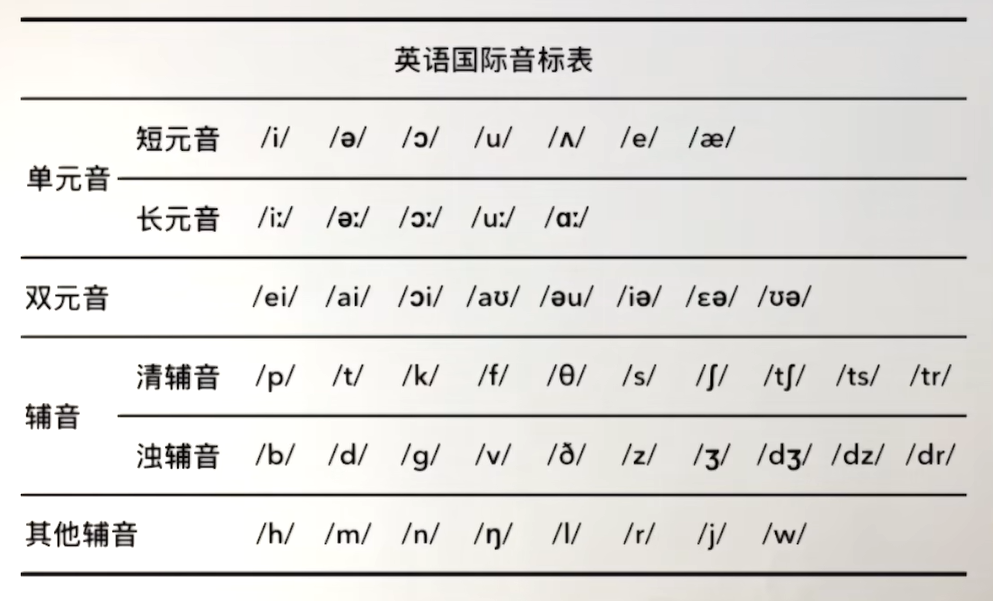
音标
词性
**adj.**:形容词
**n.**:名词
**v.**:动词
**prep.**:介词
常见介词 意思 in/on 里面/表面 across/along 穿过/沿着 over/under 在…上面/在…下面 beside/near 在…旁边 between 在…之间 into/out of 进入/出来 onto/off 上去/下来 of …的… for 为了 **adv.**:副词
单词
国家
- China / Chinese:中国 / 中国人
- France / French:法国 / 法国人
- Germany / German:德国 / 德国人
- Japan / Japanese:日本 / 日本人
- Korea / Korean:韩国 / 韩国人
- Sweden / Swedish:瑞典 / 瑞典人
- UK or Britain / British:英国 / 英国人
- USA or America / American:美国 / 美国人
- Italy / Italian:意大利 / 意大利人
- Denmark / Danish:丹麦 / 丹麦人
- Norway / Norwegian:挪威 / 挪威人
- Russia / Russian:俄罗斯 / 俄罗斯人
- Holland / Dutch:荷兰 / 荷兰人
- Greece / Greek:希腊 / 希腊人
- Brazil:巴西
- Australia / Australian:澳大利亚 / 澳大利亚人
- Austria / Austrian:奥地利 / 奥地利人
- Canada / Canadian:加拿大 / 加拿大人
- Finland / Finnish:芬兰 / 芬兰人
- India / Indian:印度 / 印度人
- Nigeria / Nigerian:非洲 / 非洲人
- Turkey / Turkish:土耳其 / 土耳其人
- Poland / Polish:波兰 / 波兰人
- Thailand / Thai:泰国 / 泰国人
颜色
- color:颜色
- green:绿色
- brown:棕色
- red:红色
- grey / gray:灰色
- yellow:黄色
- black:黑色
- white:白色
- orange:橙色
四季
- spring
- summer
- autumn
- winter
月份
- January:一月
- February:二月
- March:三月
- April:四月
- May:五月
- June:六月
- July:七月
- August:八月
- September:九月
- October:十月
- November:十一月
- Deceber:十二月
星期
Monday:星期一
Tuesday:星期二
Wednesday:星期三
Thursday:星期四
Friday:星期五
Saturday:星期六
Sunday:星期日
方向
- north:北
- south:南
- west:西
- east:东
语法
一般疑问句
一个单词提到句首
例:
- This is my handbag –> Is this my handbag?
- Pardon?(没听清,请再说一遍)
特殊疑问句
特殊疑问词 + 一般疑问句
特殊疑问词:
- What
- Where:哪里
- How:问程度,如何、怎样
- Whose:谁的
- Who:谁
- How many:多少
例:
- My name is Leo –> What’s your name?
- She is from Italy –> Where’s she from?
- I’m find –> How are you?
- this is her dress –> Whose dress is this?
- This is Jim –> Who is this young man?
否定句
is + not
例:
- This is my umbrella –> This is not my umbrella
- Leo is here –> Leo is not here / Leo isn’t here
- No, it isn’t
冠词
a / an + n.
- a + n.(首音标是辅音音标)
- an + n.(首音标是元音音标)
am/is/are
表示“是”、“在”和状态
- I + am
- You + are
- he/she/it + is
例子:
- I’m a student
- She is in the room
- He is sleeping
‘s
n. + ‘s:…的
例:
- This is Leo’s pen
复数
规则:
- these:这些
- 使用are
- s、o、x、ch、sh结尾的单词加es
- f、fe结尾的变v + es
- 辅音字母+y结尾的,y变i + es
不规则:
- man –> men
- woman –> women
- child –> children
- tooth –> teeth
give sb. sth.
给某人某物
例:
- give me a pen
人称代词放动词后面时的变形
- I –> me
- you –> you
- he –> him
- she –> her
- it –> it
- we –> us
- they –> them
on
在…的上面
例:
- on the shelf:在架子上面
A of B
B的A
例:
- In the middle of the room:在房间的中间
There be a/ab A B
某地B有某物A
例:
- There is a table in the middle of the room:房间的中间有张桌子
some/any
陈述句里的some,在否定句和疑问句里要改成any
如果希望对方肯定回答时会用some
例:
- There are some chairs in the middle of the room –> Are There any chairs in the middle of the room?
可数/不可数名词
- 可数名词 cn.
- 不可数名词 un.
- 复数不用加s
- be动词用is
判断是否不可数:
- 气体/液体
- 组成过小,如:sand/grass/hair
- 总称,如:food/fruit/money
不可数名词的形容词:
some:一些
half:一半
half a pound of coffee
a quarter of:1/4
a quarter of pound of tea
loaf:一条面包
a loaf of bread
piece:一片
bottle:一瓶
情态动词
后面动词要为原型
Can
可以、能够
用法和be动词类似
Must
必须
用法和can类似
mustn’t:禁止做…
too/either
也
肯定用too、否定用either
频率副词
位置放在be动词后面和实义动词前面
- always :总是
- usually :通常
- often :经常
- sometimes :有时
- seldom :很少
- never :从不
例:
- He is always late
- They are usually busy
- I usually get up early
- She often eats pork
时间
询问时间:
What time is it?
What’s the time?
it’s 3 o’clock
回答:
分钟数≤30时,可用:分钟 past 小时
- half past 12:12点半
- a quarter past 12:12点15分
- 13 past 12:12点13分
分钟数>30时,可用:
- 小时 : 分钟
- 分钟 to 小时
- 12:31
- 10 to 12:差10分钟12点
- a quarter to 12:差15分钟12点
have got
意思等同于have
例:
- He has a car
- He has got a car
- Does he have a car?
- Has he got a car?
many / much
在否定句 / 疑问句里常用,肯定句用 a lot of
区别:
- many修饰可数名词复数
- much修饰不可数名词
例:
- Do you have many books?
- I don’t have much money
May
May I …:我可以…吗
had better
最好去做….,否则有麻烦
结构:主语 + had better + 动词原形
例:
- You had better take an umbrella
- You’d better sleep
- You had better not eat food
人称代词
| 主格 | 宾格 | 形容词性物主代词 | 名词性物主代词 |
|---|---|---|---|
| I | me | my | mine |
| she | her | her | hers |
| he | him | his | his |
| we | us | our | ours |
| they | them | their | theirs |
| you | you | your | yours |
宾语从句
结构:
- 主语 + v. + (that) + 从句
例:
- I know that he can play basketball
反义疑问句
确认事实,类似right?
结构:
- 前肯后否、前否后肯
- 前后人称时态保持一致
例:
- He doesn’t say very mush, does he?:他没有说太多,对吧?
- Leo is in Tokyo, isn’t he?
- Leo goes to school on foot,doesn’t he?
- Sam saw me last night, didn’t he?
- Cat can’t swim, can it?
比较级 / 最高级
构成:
单音节形容词 + er / est
单音节:只有一个元音音标
small -> smaller -> smallest
new -> newer -> newest
old -> older -> oldest
单词以e结尾 + r / st
large -> larger -> largest
辅音字母 + y结尾的,把y变i + er/est
pretty -> prettier -> prettiest
辅 + 元 + 辅,双写末尾 + er /est
big -> bigger -> biggest
hot -> hotter -> hottest
不规则
many/much -> more -> most
little -> less -> least
good -> better -> best
bad -> worse -> worst
多音节形容词:前面加more / most / less / least
用法:
- 主语 + be + 比较级 + than + 比较对象
- 主语 + be + the + 最高级 + (n.) + 范围
- 主语 + be + the + 最高级 + (n.) + I’ve ever (met/seen等)
例:
- That man is older than this woman
- My father is the coolest guy in the world
- this is the craziest thing I’ve ever done
- Mother Teresa is the kindest woman I’ve ever know
- She is the most beautiful(三音节) woman in her family
little / few
结构:
- a little + un. :肯定含义
- little + un. :否定含义
- a few + cn. :肯定含义
- few + cn. :否定含义
例:
- There is a little milk in the fridge. You can drink that
- There is little milk in the fridge. We need to buy some
- I’ve a few friends, so I’m not lonely
- There are few apples in the fridge. It’s nearly empty
as…as
和…一样
例:
- The blue car is as clear as the red car
- He is as stupid as a donkey
- He is as slow as a snail(蜗牛)
- The woman is not as tall as the man
no/none
例:
- I have’t got any money == I have got no money
- We haven’t got any beer == We’ve got no beer == We’ve got none
- They aren’t any students == They’re no students == There’re none
时间状语从句
用法:
- while:在…… 期间,强调时间段、正在进行、持续动作
- when:强调时间点、瞬间动作、一… 就…
例:
- While I was reading, he came in
- When he arrived, we startd
定语从句
用来形容一个东西的外观、位置等,来确定是哪一个
结构:
- 修饰人用who / whom / that
- 修饰主语可用 who / that
- 修饰宾语可用 who / whom / that
- 修饰物用which / that
- 修是谁就紧跟谁
例:
- He is the man who met me yesterday:他就是昨天遇到我的人
- He is the man who I met yeesterday
- This is the letter which/that he sent me
时态
现在进行时
一个动作现在正在进行
结构:am/is/are + doing(v.doing 现在分词)
现在分词特殊变化规则:
结尾e不发音的,去e + ing
例:come -> coming,make -> making,dance -> dancing
结尾双写 + ing(见到了记住就行)
- run -> running
- sit -> sitting
- swim -> swimming
- put -> putting
特殊疑问句:
What + am/is/are + 主语 + doing:…正在做什么
例:what are they doing?
一般将来时
计划、打算
结构:am/is/are + going to do(do为动词原型)
口语中going to读gonna
特殊疑问句:
What + am/is/are + 主语 + going to do:….正要去做什么
例:What is she going to do?
一般现在时
客观事实/存在状态,习惯动作
加do表示强调;第三人称单数要用does,没有do则要把动词变成+s的形式
动词变第三人称单数形式规则和名词基本一样
放在实义动词的前面
例:
- 肯定句:
- I do like tea:我确实喜欢茶(do表示强调)
- He does want this job / He wants this job
- 否定句(don’t):
- I do not want this job
- I don’t like tea
- 疑问句(do提前):
- Do you want this job?
- Yes,I do
- No,I don’t
- What do you want?
- Does he want this job?
- Do you want this job?
一般过去时
过去的状态、过去发生的动作
am/is -> was
are -> were
do/does -> did
动词过去式:
直接 + ed
结尾e不发音的 + d
辅音 + y结尾:变y为ied
双写 + ed
stopped,dropped
不规则
say -> said,go -> went,understand -> understood
speak -> spoke,put -> put,buy -> bought,lose -> lost
see -> saw,take -> took,find -> found,read -> read
leave -> left,cut -> cut,eat -> ate,give -> gave
meet -> met,swim -> swam,wear -> wore,get -> got
例:
- 肯定句
- We were at home in the morning
- 否定句
- They were not at school
- She was not thirty
- This wasn’t us
- 疑问句
- Was she hungry?
- When was he at work?
现在完成时
- 过去发生的动作,对现在有影响 / 结果;
- 动作从过去一直持续到现在
过去分词变化规则:
规则:同过去式
不规则:
be -> been、go -> gone、see -> seen、bring -> brought(带来)
结构:
- 肯定句:主 + have done(过去分词)
- 否定句:主 + have not done(过去分词)
- 一般疑问句:Have + 主语 + done(过去分词)
例:
- I have had lunch:我吃过午饭了
- I’ve just had a cup:我已经喝过一杯了
- Have you just been to a cinema?
- I have studies English for 10 years(动作持续到现在)
一般将来时
意愿、临时决定
结构:
- 肯定句:will do(原型)
- 否定句:will not / won’t
- 一般疑问句:will 提到句首
例:
- I will help you:我来帮你(临时决定要帮)
过去进行时
结构:was / were + doing
例:
- I was doing my homehork at 8 o’clock last night
- We were swimming in the river at 4 o’clock yesterday afternoon
过去完成时
强调过去某个动作发生在另一个动作之前
结构:had + done(过去分词)
例:
- After I had seen the film,I read the book:看完了电影后,我看了书
- I read the book after I had senn the film:同上
- After I had sold the old car, I bought a new one
- After he had got out of the car, he said goodbye to the taxi driver
- Before they ate the dinner,they had wished their hands
- They had wished their hands before they ate the dinner
词组 / 短语
on the house:记在店家的账上,表达免费
The drinks are on the house.
ticket:票
- one way ticket:单程票
- return ticket:往返票
- one ticket to …:去…的票
take my … / here is my …:给你我的….
it suits me:这适合我
打招呼:
- Nice to meet you
- What’s up, man
- Sup, man
What brand is this?:这个是什么牌子的
What do you do for a living?:你是做什么工作的
Lazy bones:懒骨头
Perhaps it is:大概是
Here it is:在这儿
It is the same color:一样的颜色
My treat:我请客
on me / you:我/你请客
What’s the matter?:怎么了?
What’s wrong?:怎么了?
sit down:坐下
turn on / turn off:打开/关闭(电器等)
open / shut:开 / 关(门窗等)
take off:摘下、脱下
look at:看着
give me another month:再给我一个月
for sb.:给某人
in front of:在…前面
in the front of:在…前排
Be careful:小心
do with sth.:处理某事
What is he going to do with the refrigerator
it’s over there:(用手指着)在那里
wait a minute:等一下
piece of cake:小菜一碟
do …:表示强调
I do like tea
How do you like steak?:你要几分熟的牛排
come from:来自
He comes from Greece
Does he come from Greece?
Where does he come from?
have a conversation:对话
live in 国家 / live at 门牌号:居住在…
on foot:用走着去
at the moment:在此刻
What’s the matter with you?:你有什么毛病(负面)
Shut your mouth:闭嘴
Take some medicine:吃药
lean out of:探出
enjoy yourself:玩得开心
the day before yesterday:前天
How many times:多少次
Suddenly:突然
go hand in hand:携手并进
buy us more time:给我们争取时间
a lot of:许多,可数不可数都可以用
have a drink:喝一杯
have fun / have a good time:玩得开心
make a mess:弄乱、制造混乱
have been/gone to:去过(回来了) / 去了(还没回来)
… yet:已经
… at all:完全
have a look at it == look at it:看看它
try to repair:尝试修理
turn it on:人称代词必须放中间,名词可以放后面也可以放中间
turn off the TV、turn the TV off
pound / penny:英镑 / 便士
It‘s was worth every penny:物有所值
for sale:待售
have the last word:有最后决定权
leave for:离开然后去某地
Are you sure about this?:你确定吗
too …:太…(负面)
The wall is too high for me to climb
… enough:足够…
this is big enough
cheer up:振作起来
want to do(动词原形) sth. / wanna do sth. :想做….
I want to buy a new car
tell sb. to do(动词原形) sth. :告诉某人某事
Please tell him to bring me some coffee
make a mistake:犯错
How do you spell “单词”:这个单词你怎么拼写
be full of:充满了…
This letter’s full of mistake
would like:类似want,更委婉
I would like some tea
Would you like some tea? = Do you like some tea?
would like + to do sth.:愿意去做某事
I would like to help him
Would you like to help him?
buy sth. on instalments:分期付款买
so + 助动词/情态动词/be + 主语(肯定) / neither + 助动词/情态动词/be + 主语(否定):我也是
助动词/情态动词/be就是疑问句提前的那个单词
I have a happy family – so do I
I don’t want work – Neither do I
I can’t speank Chinese – Neither can I
have to:必须、不得不(客观原因)(must的必须是主观原因)
I have to leave now
I don’t have to leave now
She has to leave now
She doesn’t have to leave now
和must的比较:
- This is a terrible pary, we really must go home
- This is lovely place, but I have to go home because of my daughter
must be:推测,一定是…
can’t be:推测,不是….
不规则动词变形
完全一样
| 原形 | 过去式 | 过去分词 | 中文 |
|---|---|---|---|
| cut | cut | cut | 切,割 |
| put | put | put | 放 |
| read | read | read | 读 |
| set | set | set | 放置 |
| shut | shut | shut | 关闭 |
| hurt | hurt | hurt | 受伤、伤害 |
过去式和过去分词一样
| 原形 | 过去式 | 过去分词 | 中文 |
|---|---|---|---|
| buy | bought | bought | 买 |
| find | found | found | 找到 |
| get | got | got | 得到 |
| have | had | had | 有;吃 |
| hear | heard | heard | 听见 |
| leave | left | left | 离开 |
| lose | lost | lost | 丢失 |
| make | made | made | 制作 |
| meet | met | met | 遇见 |
| send | sent | sent | 发送 |
| sweep | swept | swept | 扫 |
| tell | told | told | 告诉 |
| sell | sold | sold | 卖 |
| spell | spelt | spelt | 拼写 |
| mean | meant | meant | 意味 |
不一样
| 原形 | 过去式 | 过去分词 |
|---|---|---|
| go | went | gone |
| see | saw | seen |
| do | did | done |
| come | came | come |
| eat | ate | eaten |
| take | took | taken |
| give | gave | given |
| drive | drove | driven |
| swim | swam | swum |
| rise | rose | risen |
| speak | spoke | spoken |
| fly | flew | flown |
| ride | rode | ridden |
| fall | fell | fallen |
| forget | forgot | forgotten |